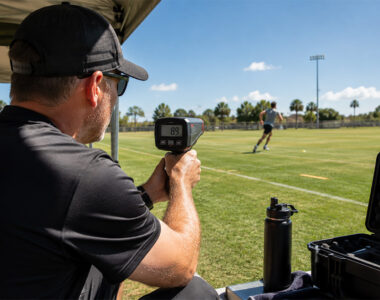
Football has become increasingly data-driven. Coaches no longer have to rely entirely on what they see on film or how fast a pass, punt, or kickoff appears to be. Radar technology can provide measurable information about how a football travels through the air, helping quarterbacks, kickers, punters, coaches, trainers, and scouts evaluate performance.
While radar guns are often associated with baseball, they have an important place in football as well. From measuring quarterback throwing velocity to analyzing kicks and punts, radar technology is being used at the college and professional levels to turn speed and ball-flight performance into objective data.
However, there is an important distinction: handheld radar guns are used primarily during practices, workouts, combines, camps, and evaluations. During NFL games, the league relies heavily on a much broader electronic tracking system rather than someone simply standing on the sideline with a radar gun.
Here’s how radar technology fits into football today.
Measuring Quarterback Throwing Velocity
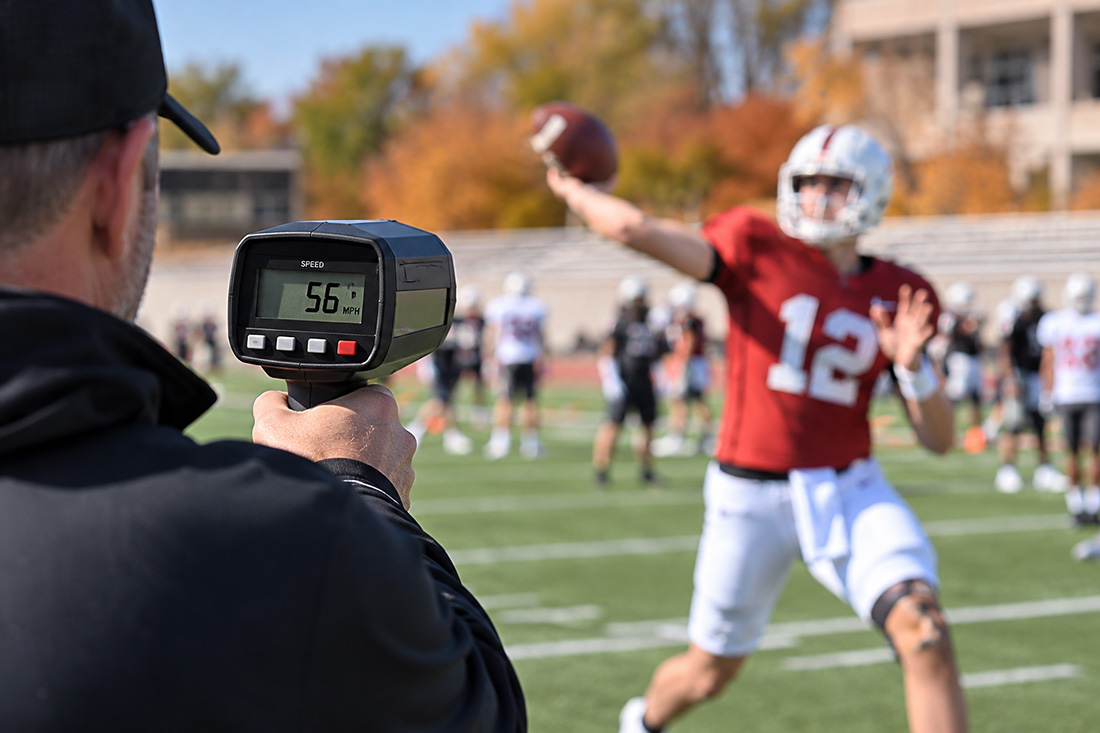
One of the most obvious uses for a radar gun in football is measuring how fast a quarterback throws the ball.
Arm strength has always been part of quarterback evaluation, but simply saying a quarterback has a “strong arm” is subjective. A radar gun provides an actual velocity reading in miles per hour.
Radar measurements have historically been used during quarterback evaluations surrounding the NFL Scouting Combine. NFL.com has reported quarterback velocities measured with radar guns during Combine workouts, including throws approaching 60 mph.
During training, coaches can use radar readings to evaluate different types of throws, such as:
- Short timing routes
- Intermediate passes
- Deep balls
- Out routes
- Rollout throws
- Quick-release passes
- Throws made from different platforms
The goal isn’t necessarily to throw every pass as hard as possible. Quarterbacks need touch, timing, accuracy, and anticipation. But measuring velocity gives coaches another piece of information when evaluating arm strength and throwing mechanics.
Using Radar Guns During Quarterback Practice
Practice is where radar guns can become particularly useful.
A coach can record several throws rather than relying on a quarterback’s single fastest attempt. Over time, these readings can reveal patterns.
For example, a quarterback might average 54 mph early in a workout but drop several miles per hour after a large number of repetitions. Coaches can then look more closely at mechanics, fatigue, footwork, or consistency.
Radar testing can also help quarterbacks compare different techniques.
A coach might evaluate whether a quarterback maintains velocity when:
- Throwing from a traditional pocket
- Moving to the right or left
- Throwing without perfectly set feet
- Delivering the ball quickly under simulated pressure
- Attempting longer throws
Modern radar-based football systems go beyond a single MPH number. TrackMan’s American football technology, for example, uses radar to track full ball flight and provide immediate feedback on throws and kicks. The company specifically positions the technology for quarterback and specialist development, scouting, and performance benchmarking.
Radar Technology for Kickers
Placekicking is another area where radar data can be valuable.
Two field goals can both travel through the uprights while having very different trajectories. One may have significantly more initial velocity, height, or distance potential.
Advanced radar systems can help analyze how a kicker strikes the football and how that ball travels afterward.
Coaches can look at factors such as:
- Ball velocity
- Launch trajectory
- Distance
- Direction
- Consistency between attempts
- Overall ball flight
This becomes especially useful when a kicker is making mechanical adjustments.
Instead of simply telling the player that a kick “looked better,” coaches can combine video with measurable ball-flight information.
Repeated testing can also establish performance benchmarks. A kicker can compare today’s results with measurements recorded several weeks or months earlier.
Radar Technology for Punters
Punters may benefit even more from detailed ball-flight measurements.
Punting isn’t simply about kicking the football as far as possible. Coaches care about the combination of distance, direction, hang time, placement, and consistency.
Modern radar-based systems can measure factors including kick velocity, launch angle, hang time, and placement.
That data can help specialists experiment with different approaches.
For example, a punter may be trying to increase hang time without sacrificing too much distance. Instead of relying entirely on a stopwatch and visual observation, radar-based tracking provides another objective way to evaluate the result.
The same concept can apply to directional punting, where placement may be just as important as maximum distance.
College Football Recruiting and Player Evaluation
Radar technology can also have value in college football recruiting and player development.
College coaching staffs receive enormous amounts of film and performance data on prospective athletes. Objective measurements provide another way to evaluate players.
For quarterbacks, throwing velocity may help demonstrate arm strength.
For kickers and punters, measurable ball-flight data can provide information about leg strength, trajectory, hang time, and consistency.
Radar technology should never replace film or live evaluation. A quarterback who throws extremely hard but lacks accuracy or decision-making isn’t automatically a better prospect. Likewise, a kicker with impressive ball velocity still needs consistency under pressure.
The advantage of radar data is that it gives coaches another measurable reference point.
Advanced football radar platforms now allow performance data to be compared against collegiate and professional benchmarks, giving coaches and scouts additional context when evaluating player development.
Are Radar Guns Used During Actual NFL Games?
This is where football technology gets particularly interesting.
Radar technology certainly has applications in football, but the official player-speed information seen during NFL broadcasts isn’t normally coming from a coach pointing a handheld radar gun at players.
The NFL has developed a far more comprehensive system called Next Gen Stats.
According to NFL Football Operations, NFL stadiums use ultra-wideband receivers along with RFID tags placed in players’ shoulder pads. Tags are also used on officials, pylons, chains, sticks, and footballs. The system tracks information such as player location, speed, distance traveled, and acceleration multiple times every second.
That technology allows the league to produce statistics such as:
- Maximum player speed
- Distance traveled
- Player positioning
- Routes
- Coverage information
- Formation data
- Completion probability
- Expected rushing yards
More than 200 data points can be generated on every play, according to NFL Football Operations.
So while a traditional radar gun remains useful for targeted speed measurements, modern NFL game tracking has evolved into an entire network of sensors and analytics.
Radar Guns vs. NFL Tracking Technology
The two technologies serve somewhat different purposes.
A radar gun is excellent when the question is simple:
How fast did that football travel?
That makes handheld radar particularly practical for practices, quarterback training, camps, combines, showcases, and individual workouts.
Advanced radar systems take this idea further by tracking the football’s complete flight.
NFL game-tracking systems answer much broader questions:
Where was every player? How fast were they moving? Where was the football? What happened throughout the entire play?
That requires sensors, receivers, computing systems, and analytics rather than one handheld radar gun.
Both technologies demonstrate the same overall change happening in football: performance is becoming increasingly measurable.
Combining Radar Data With Video
One of the best ways to use radar information is alongside video.
Suppose a quarterback produces a noticeably faster throw during practice.
The coach can review the video to see what changed:
- Was the quarterback’s footwork better?
- Did the hips rotate more efficiently?
- Was the release quicker?
- Was the throwing motion more compact?
The same process can be used with kickers and punters.
Radar provides the number. Video can help explain why the number changed.
Combining those tools can give coaches a more complete picture of performance than either measurement alone.
Radar Data Should Measure Consistency, Not Just Maximum Speed
Athletes naturally want to know their highest number.
A quarterback might want the hardest throw. A kicker may want the most powerful kick.
But coaches can often learn more from consistency.
Instead of recording only the fastest attempt, radar guns can be used to track multiple repetitions.
Consider these quarterback readings:
54 mph — 55 mph — 54 mph — 55 mph — 54 mph
That pattern may tell a coach more than one isolated 58 mph throw surrounded by much slower attempts.
Football depends on repeatability.
The quarterback must deliver accurate passes throughout a game. Kickers need to reproduce their technique under pressure. Punters need reliable distance and placement.
Radar data becomes most useful when it helps athletes build that consistency.
Football Is Becoming More Data-Driven
Technology has changed how NFL and college football programs evaluate performance.
Film remains essential. Coaching experience remains essential. Game performance remains the ultimate test.
But radar technology adds another layer of information.
For quarterbacks, radar guns can quantify throwing velocity.
For kickers and punters, advanced radar systems can evaluate ball flight, velocity, launch characteristics, hang time, and placement.
And during NFL games, sophisticated player and football tracking systems now collect information on virtually every play.
For coaches, trainers, athletes, football camps, schools, and performance facilities that don’t require an NFL-level tracking network, a quality sports radar gun offers a much simpler way to introduce measurable speed data into football training.
Radar Sports offers radar guns and speed-measurement equipment for football training, quarterback development, sports camps, combines, and other athletic applications. Visit RadarGunSales.com to explore radar equipment and find the right solution for your program.