When most people think about radar guns, baseball pitching is usually the first application that comes to mind. However, radar technology can measure much more than fastballs. Coaches, athletes, trainers, schools, and sports organizations can use radar guns across a wide range of summer sports to measure speed, evaluate technique, and make training more engaging.
From tennis courts and soccer fields to football camps and lacrosse practices, a radar gun provides immediate, objective feedback. Instead of guessing whether an athlete is improving, coaches can record measurable results and track progress throughout the summer.
Why Use a Radar Gun for Summer Sports Training?
Speed plays an important role in many competitive sports. A faster tennis serve, soccer shot, lacrosse release, or football pass can place additional pressure on opposing players and create more scoring opportunities.
A radar gun allows athletes and coaches to:
- Establish a starting speed
- Measure performance during drills
- Track improvement over time
- Compare different techniques
- Create measurable training goals
- Add competition and excitement to practices
Radar readings should not be treated as the only measure of performance. Accuracy, control, mechanics, decision-making, and consistency are equally important. However, speed data can provide valuable insight when it is combined with proper coaching.
Measuring Tennis Serve Speed
Summer is a busy season for tennis lessons, camps, tournaments, and outdoor practice. A radar gun can help players measure the speed of their first and second serves while working on power, placement, and consistency.
Coaches can record several serves instead of focusing on one unusually fast attempt. This provides a more reliable picture of the player’s typical serve speed.
Players can also compare how different adjustments affect performance, including:
- Ball toss position
- Leg drive
- Racquet acceleration
- Contact point
- Body rotation
- Follow-through
The fastest serve is not always the best serve. A player who adds speed but loses placement may not improve overall performance. The goal is to develop a serve that combines velocity with accuracy and repeatability.
For summer tennis camps, radar guns can also be used to create serve-speed challenges. These activities make practice more interactive while introducing young players to measurable performance goals.
Tracking Soccer Shot Speed
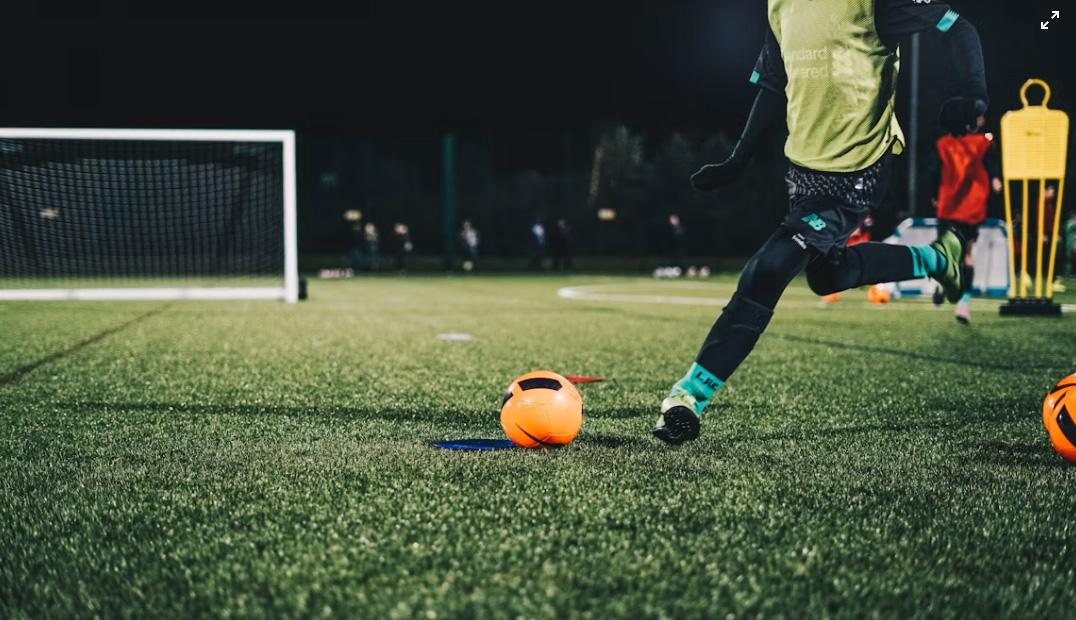
Soccer players can use radar guns to measure the speed of penalty kicks, free kicks, long-distance shots, and other striking drills. The reading gives players immediate feedback about how efficiently they are transferring power through the ball.
Coaches can compare different approaches to the shot, including plant-foot position, body angle, contact location, balance, and follow-through. Players may discover that better mechanics produce more speed without requiring them to swing their leg harder.
Radar guns can be useful during:
- Shooting practices
- Penalty-kick drills
- Free-kick training
- Goalkeeper reaction drills
- Soccer camps and clinics
- Team competitions
Shot speed should always be evaluated alongside accuracy. A powerful shot that consistently misses the target is less effective than a controlled shot placed into a difficult area for the goalkeeper.
Radar displays can also add excitement to soccer events. Players can take turns testing their hardest shots while spectators see the results immediately on an LED speed display.
Improving Lacrosse Shot Speed
Lacrosse is another sport where release speed can make a significant difference. Offensive players often have limited time to receive the ball, create space, and shoot before a defender or goalkeeper reacts.
A radar gun can measure shot velocity during stationary shooting, running shots, time-and-room attempts, and quick-release drills. Coaches can use this information to help players understand how footwork, hand placement, core rotation, and stick mechanics affect speed.
Rather than encouraging athletes to swing as hard as possible, coaches can use radar data to reinforce efficient movement. A smooth, technically sound shot may generate more velocity than a forced attempt with poor balance.
Radar guns are also valuable for lacrosse goalkeepers. Seeing realistic shot-speed data helps coaches design drills that match the level of competition a goalkeeper may face.
Evaluating Football Throwing Velocity
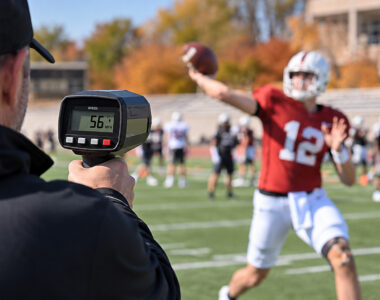
Summer football camps often focus on quarterback mechanics, footwork, timing, accuracy, and arm strength. Radar guns can provide another useful layer of information by measuring pass velocity.
Quarterbacks can test different throws, including:
- Short timing routes
- Intermediate passes
- Deep throws
- Rollout passes
- Throws from different platforms
- Quick-release drills
Coaches can examine whether a quarterback maintains velocity while moving or throwing under pressure. They can also compare arm speed before and after mechanical adjustments.
However, velocity alone does not determine quarterback performance. A successful pass must arrive on time and in a catchable location. Radar readings are most useful when combined with completion percentage, release time, footwork, and decision-making.
Receivers can benefit from these drills as well. Practicing with passes at different speeds can help improve reaction time, hand strength, concentration, and catching technique.
Using Radar Guns for Hockey Training
Although hockey is often associated with winter, many athletes continue training during the summer through indoor leagues, shooting facilities, camps, and off-ice practice programs.
Radar guns can measure slap shots, wrist shots, snap shots, and one-timers. Players can compare shot types and determine which mechanical changes produce greater speed.
For example, athletes may test how weight transfer, stick flex, hand position, and puck placement affect the final reading. Coaches can record multiple attempts to identify consistent performance rather than emphasizing a single maximum-speed shot.
Radar technology can also be used during street hockey or roller hockey training. This gives players an opportunity to continue developing shooting power during the offseason.
When using a radar gun around hockey nets or shooting cages, equipment should be positioned safely and protected from direct impacts.
Other Summer Sports That Can Use Radar Technology
Radar guns can be applied to many other sports and recreational activities.
Volleyball
Coaches can measure serve speed and evaluate how different serving techniques affect velocity. Players can compare standing serves, float serves, and jump serves while maintaining control.
Pickleball
Radar readings can be used to measure serves, drives, overhead smashes, and other fast shots. The data can help players understand how paddle acceleration and contact quality influence ball speed.
Field Hockey
Players can measure shot and pass speeds during offensive drills. Coaches can evaluate striking technique while continuing to emphasize control and accuracy.
Track-and-Field Throwing Events
Radar technology may be used in selected training environments to evaluate the release speed of thrown objects. Placement and setup are especially important because the radar gun must be aligned properly with the object’s direction of travel.
Community Events and Fundraisers
Radar guns are also popular for speed challenges at summer fairs, school events, sports fundraisers, company picnics, and community festivals. Participants can test a throw, kick, serve, or shot while an LED display shows the result.
These activities can attract attention, encourage friendly competition, and create a memorable experience for participants.
How to Get More Accurate Radar Readings
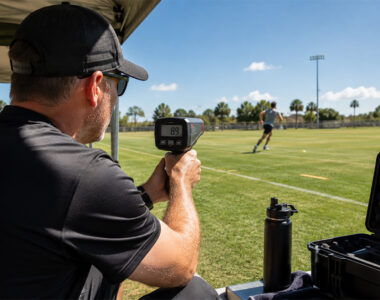
Correct positioning is essential when measuring sports performance. A radar gun works best when it is aimed as directly as possible along the path of the moving ball, puck, or object.
Holding the radar gun at a sharp angle may produce a lower reading than the object’s actual speed. This is commonly known as the cosine effect.
For more consistent results:
- Position the radar gun in line with the direction of travel
- Keep a safe distance from athletes and moving objects
- Use the same general setup for each attempt
- Avoid unnecessary movement while taking readings
- Record multiple attempts
- Follow the manufacturer’s operating instructions
- Protect the equipment from excessive heat and moisture
When comparing results over time, try to recreate similar conditions. Changes in distance, angle, drill design, or equipment can affect the numbers.
Turn Summer Training Into Measurable Progress
Radar guns can make summer sports training more focused, competitive, and engaging. Athletes receive instant feedback, while coaches gain objective data that can support technical instruction and long-term development.
Whether measuring a tennis serve, soccer shot, lacrosse release, football pass, or hockey shot, the goal is not simply to produce the highest possible number. The greatest value comes from using speed measurements alongside accuracy, mechanics, consistency, and sport-specific performance.
Radar Sports offers radar guns and speed displays from leading manufacturers for athletic training, camps, tournaments, team programs, and community events. Explore the available radar equipment at RadarGunSales.com to find the right solution for your summer sports application.